
|
|
augustus of primaporta c.20 CE marble, roman imperial
like.Polykleitos of style,high classical
refers to athenian golden age threw style shows his greatness comparisions to the gods implied c. 20 CE, marble, Roman I mperial
*Augustus of Primaporta
c. 20 CE, marble, Roman Imperial
|
|
|

|
Flavian Amphitheater (colosseum) 72-80 CE Rome, Roman Imperial
great use of |

|
|
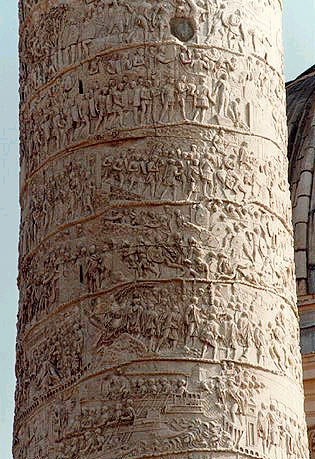
column of trajan 106-113 CE marble, forum of trajan Rome, Roman Imp. |
|
|
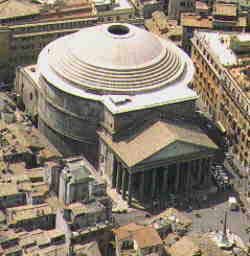
Pantheon c.117-125 CE, concrete and marble, Rome, Roman Imp. |
| triumphal arch |
|
a monumental archway; usually they are built to commemorate some notable victory
ex. Arch of Titus
|

| allegory |
|
an art form, as a story, painting, or sculpture, in which the components have a symbolic, figurative meaning
ex. triumph of titus (arch of titus) |
| forum |
|
a public meeting or assembly for open discussion
ex.apollodorus of damascus, market of trajan |
| basilica |
|
a Roman building, used for public administration, having a large rectangular central nave with an aisle on each side and an apse at the end
ex.basilica ulpia
|

| apse |
|
A usually semicircular or polygonal, often vaulted recess, especially the termination of the sanctuary end of a church
ex.basilica ulpia |
| colonnade |
|
a set of evenly-spaced columns
ex.basilica ulpia
|
| nave |
|
The central part of a church, extending from the narthex to the chancel and flanked by aisles
ex.basilica ulpia |
| continous narritive |
|
ex. column of trajan
|
| oculus |
|
A circular opening at the apex of a dome
a round window
ex.pantheon |
| coffer |
|
A decorative sunken panel in a ceiling, dome, soffit, or vault
ex. pantheon |

|
|
Scenes of Dionysiac Mystery Cult c. 60-50 BCE wall painting, Pompeii, Roman Rep. House
very fine frescos
was damaged during eruption of mt. vesuvius |
|
|
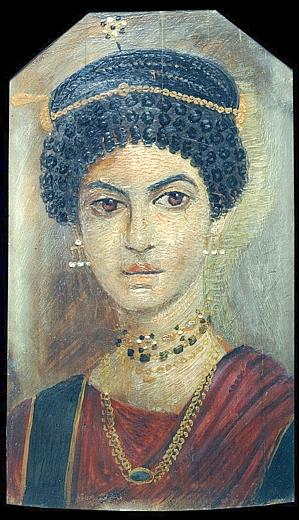
portrait of a women c.100-130 CE, encaustic on wood panel, Roman Imp |

|
|
Equestrian Staue of Marcus Aurelius c.176 CE bronze, Rome, Roman Imp. |
| atmosperic perspective |
|
a technique used by painters for representing three-dimensional space on a flat two-dimensional surface by creating the illusion of depth, or recession within a painting or drawing.
ex.Gardenscape
|

| still life |
|
a painting or drawing of inanimate objects, such as fruit, flowers, etc.
ex. still life with peaches and a water jar, wall painting from herculaneum |
|
encaustic |
|
decorated by any process involving burning in colours, esp by inlaying coloured clays and baking or by fusing wax colours to the surface
ex.Portrait of a Women, Roman Imp.
|

|
|
the tetrarchs c.305 CE, Porphyry, from Constantinople, now in San Marco,, Venice , Roman Imp. |
|
|
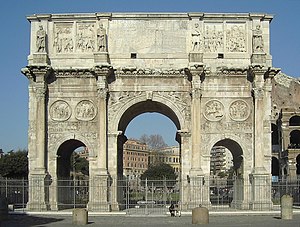
arch of constantine c.312-315, marble, Rome, Roman Imp.
filled out wth spoilia, spoils of war |

|
|
constantinian frieze(from arch of constantine) 312-315 CE, marble, Rome, Roman Imp. |
| tempra |
|
a painting medium for powdered pigments, consisting usually of egg yolk and water
ex. septimmius severus and his family, wood cirle plate |
|
damnatio memoriae |
|
the Latin phrase literally meaning "damnation of memory", in the sense of removed from the remembrance. It was a form of dishonor
the cratching out of the face of the brother to Emperor Carcalla
ex. septimmius severus and his family, wood cirle plate |
|
spolia |
|
a modern art-historical term used to describe the re-use of earlier building material or decorative sculpture on new monuments. The practice was common in late antiquity:
ex. the earlier imperial reliefs reused on the Arch of Constantine |
| diptych |
|
object with two flat plates attached at a hinge
n Late Antiquity, ivory diptychs with covers carved in low relief on the outer faces were a significant art-form
ex.Prietess of Bachus
|


|
|
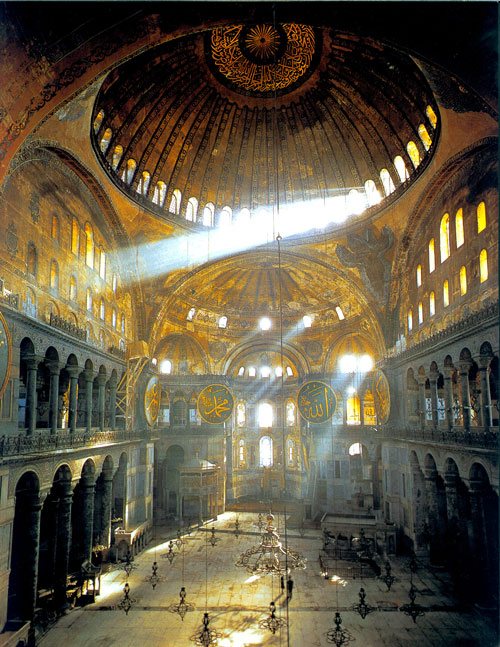
anthemius of tralles and isidorus of miletus hagia sophia 532-537 CE, Istanbul, Byzantine
|

|
|
Emperor Justinian and his Attendants, San Vitale, Ravenna c 547 CE, mosaic, Byzantine |

|
|
Empress Theodora and her attendants, San Vitale, Ravenna c 547 CE, mosaic, Byzantine |
| pendentive |
|
a constructive device permitting the placing of a circular dome over a square room or an elliptical dome over a rectangular room
ex. Hagia Sophia |
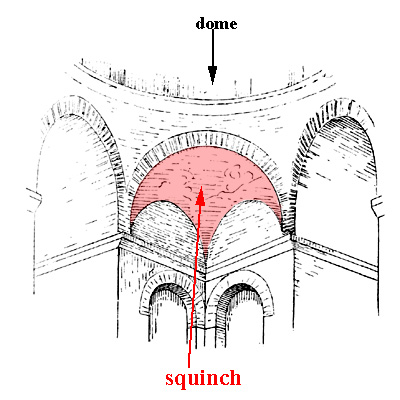
| squinch |
|
a piece of construction used for filling in the upper angles of a square room so as to form a proper base to receive an octagonal or spherical dome
|

|
|
Justinian As Conquerer c. 525-550 CE, ivory, Byzantine |

|
|
Rebecca at the Well (from the Vienna Genesis) early 6th century, tempra gold n silver paint on purple dyed vellum Syria, Byzantine |

|
|
Virgin and Child with Saints and Angels late 6th century encaustic on wood from the monastery of st. catherine Mt. Sinai, Egypt, Byzantine |
| manuscript illumination |
|
a manuscript in which the text is supplemented by the addition of decoration, such as decorated initials, borders (marginalia) and miniature illustrations. In the strictest definition of the term, an illuminated manuscript only refers to manuscripts decorated with gold or silver
ex.Rebbeca at the well
|
| codex (pl. codices) |
|
a book in the format used for modern books, with separate pages normally bound together and given a cover
gradual replacement of the scroll,
the dominant form of book in the ancient world, has been
termed the most important advance in the history of the book prior to the invention of printing
The spread of the codex is often associated with the rise of Christianity, which adopted the format for the Bible early on |
| icon |
|
a representation of Christ, the Virgin Mary, or a saint, esp one painted in oil on a wooden panel, depicted in a traditional Byzantine style and venerated in the Eastern Church
ex.christ |
| iconoclasm |
|
The beliefs, practices, or doctrine of an iconoclast
or:the practice of destroying images, especially those created for religious veneration |
| intercessor |
|
a negotiator who acts as a link between parties,
or a item that one uses in prayers as a medium between them and god |
| triptych |
|
A work consisting of three painted or carved panels that are hinged together.
often used to brings religous icons/ll intercessor around in saftey
ex.Harbavillee Triptych |

|
|
Consecreation of the Tabernacle and its priests house-synagogue, Dura-Europos, Syria c. 245-246 CE, Jewish |

|
|
The good shepherd, Orants and the Story of Jonah painted ceiling of the catacombs of SS.Peter and Marcellinus, 4th century CE, Rome, Early Christian |

|
|
Santa Maria Antiqua Sarcophagus c. 270 CE, marble, Early Christian |
| synagogue |
|
a building for Jewish religious services and usually also for religious instruction
ex. house -Synagogue, Dura-Europos |
| iconic |
|
(of memorial sculptures, esp those depicting athletes of ancient Greece) having a fixed conventional style
or of religous style
ex. wall with the torah niche, house synagogue. Jewish 245 CE |
| narrative |
|
The art, technique, or process of narrating.
ex. wall with the torah niche, house synagogue. Jewish 245 CE |
| catacomb |
|
1. An underground cemetery consisting of chambers or tunnels with recesses for graves. Often used in the plural.
2. An underground, often labyrinthine passageway.
ex.
|
| syncretism |
|
Reconciliation or fusion of differing systems of belief, as in philosophy or religion, especially when success is partial or the result is heterogeneous.
ex. the good shepherd, orants and the story of jonah, painted of the catacomb cielding f st. petersburg |
| typology |
|
Chiefly Christian theol the doctrine or study of types or of the correspondence between them and the realities which they typify
the analysis of symbolism, especially of the meaning of Scripture types
ex. the good shepherd, orants and the story of jonah, painted of the catacomb cielding f st. petersburg |

|
|
old st.peter's basilica (reconstruction) c. 324-400 CE, brick and timber, Rome, Early Christian |

|
|
santa costanza c. 350 CE, brick and marble, Rome, Early Christian
central -plan church ambulatory |

|
|
the good shepherd (from the oratory of galla placidia, ravenna, italy) c. 425-426 CE, mosaic, early christain |
|
|
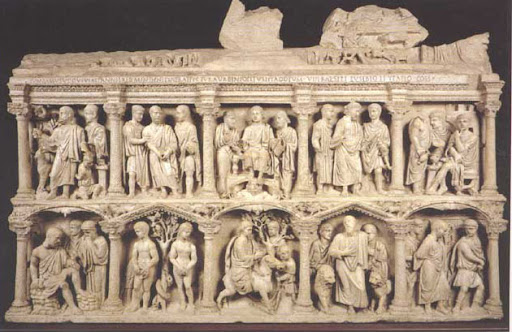
sarcophagus of Junius Bassus c.359 CE, marble, early christian
top right >:sacrifice of isaac,arrest of peter,enthroned christ with Peter n pual,arrest of christ,potius pilate
bottom right >:job, adam n eve, christ entry into jerusalem, daneil in the lion den, arrest of pual |
| longitudinal plan |
|
a plan in which length exceeds width
Many of the earliest churches of Byzantium have a longitudinal plan.
ex. Hagia Sophia, Istanbul
ex. old st. peters basilica
|
|
transept |
|
The transverse part of a cruciform church, crossing the nave at right angles
either of the two wings of a cruciform church at right angles to the nave
ex. old st. peters basilica
|
| nave |
|
The central part of a church, extending from the narthex to the chancel and flanked by aisles.
ex. old st. peters basilica
|
| aisle |
| A part of a church divided laterally from the nave by a row of pillars or columns. |
| central-plan church |
|
A church that has a design with a primary central space surrounded by symmetrical areas around each side.
aka a circle in the middle or main area
ex. santa costanza church |
| ambulatory |
|
an aisle running around the east end of a church, esp one that passes behind the sanctuary
ex. santa costanza church |
| aniconism |
|
the worship of an object symbolizing, but not representing God.
an opposition to icons or idols
ex. Kaaba, Mecca, Saudi Arabia |

|
|
Dome of the Rock, Jerusalem c.690 CE, Islamic
lots of islamic writing in gold used at decorations on the walls cental plan |
| qibla wall |
|
larger wall with something that inticates which direction Mecca so as to pray in that direction
ex. the great mosque of kairouarn, tunisia |
| mihrab |
|
A niche in the wall of a mosque or a room in the mosque that indicates the direction of Mecca
ex. the great mosque of kairouarn, tunisia |
| minaret |
|
A tall slender tower attached to a mosque, having one or more projecting balconies from which a muezzin summons the people to prayer.
ex. the great mosque of kairouarn, tunisia |

|
|
Prayer Hall, Great Mosque, Cordoba Spain begun 785 CE, Islamic
alternating voussoirs
horeshoe arch |
|
alternating voussoirs
|
|
A voussoir is a wedge-shaped element, typically a stone, used in building an arch or vault, common in romanesque arab architexture
ex.Prayer Hall, Great Mosque, Cordoba Spain
begun 785 CE, Islamic
|
|
horeshoe arch
|
|
The horseshoe arch, also called the Moorish arch and the Keyhole arch, is the emblematic arch of Islamic architecture
ex. Prayer Hall, Great Mosque, Cordoba Spain
begun 785 CE, Islamic
|


|
|
Page from the Qur'an 9th century, Black ink and gold on vellum Syria, Islamic
like. rebecca at the wall |